Commemorating the 10th Anniversary year of the Modern Mardukite movement, JOSHUA FREE breaks four years of media silence with a guest appearance on “A World of Weird” podcast…and YOU are invited!
Take a moment now and spend a candid hour with Joshua Free as we explore the relevance of ancient mysteries not taught in schools concerning the oldest collected written records of our civilization detailing the race of Anunnaki in ancient Mesopotamia… a literary collection that some today recognize as the NECRONOMICON ANUNNAKI BIBLE.
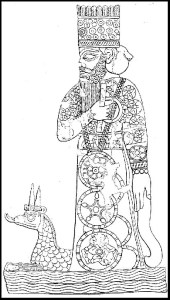
“When MARDUK decided to raise himself to the ‘God’ status for NABU’s new Babylonian monaltric religious system, new political issues ignited for Anunnaki on Earth… other Anunnaki were less than appreciative of MARDUK’s desire to reign over them. Although the Age of Aries, his sign, did come, the glory that should have been his, was never granted — a disciplinarian act by the other gods.”
— explains Joshua Free in theGATES OF THE NECRONOMICON anthology.
MARDUK lost rights of official Anunnaki kingship “in heaven” for taking a “human” wife, instead of his betrothed half-sister INANNA-ISHTAR. He argued (to the Anunnaki Assembly) that SARPANIT (his chosen consort, mother of NABU) was descended from ADAPA [see the Necronomicon Annunnaki Bible], and therefore of ENKI‘s (Anunnaki) bloodline; further, that INANNA-ISHTAR was no more interested in the union than he was (and it had not affected her rise to power); and finally, if not “in heaven,” why not “on earth”?
While we are forced to guess how the other Anunnaki chose to respond to MARDUK, resulting catastrophes in the Middle East — and the thousands of years of unrest thereafter — show evidence to believe this arrangement between factions did not occur peacefully.
-A-MARDUKITE-LEGACY-BORN-
BLOODLINES
In Assyrian accounts, MARDUK, as the great “father-god” Assur or Ashur [“Ashshur”], seems to emerge as if from nowhere. Some scholars in the late 1800’s and early 1900’s considered this to mean the idea of the Babylonian Holy Family — MARDUK, SARPANIT and NABU — as being fictitious figures imagined into being by the priest-scribes for purely political reasons.
SARPANIT [also SARAPAN or ZARPANITU] is mentioned often in (Mardukite) Babylonian prayers (incantation tablets) but does not appear in any recovered mythic/epic tablet cycles from Babylon. Politically, she achieves an elevated status (where ISHTAR is an Anunnaki Queen, SARA-PAN becomes literally “Princess“) by her relationship with MARDUK. Together, they are the parents of NABU, patron of the scribe-priests hosting Babylonian Religion — called Mardukite. At the spring equinox — A.KI.TI New Year festival — she is the “spring-maiden” of Babylonian fertility festivals.
Being absent in the genealogies of ENKI and ENLIL as well as the Igigi (igi-igi, Watchers), Mardukites acknowledge SARPANIT as an “earthling” or “earthborn” demi-god (part-divine) by birth [given the accounts of the Creation of Adapa].
SARPANIT is also known as ERUA, or more appropriately, ERU. European magical-clans of hereditary occultism, such as “Stregherians” “Elven-Faerie” “Vampyre”– bloodlines acknowledging descent fromMARDUK — gave to their “Star-Goddess Mother of Vegetation and Fertility” …and sure enough eru is an Akkadian word for pregnancy…
NECRONOMICON ANUNNAKI BIBLE The Babylonian Mardukite Tradition
by Joshua Free
2009 — Complete Year-1 Liber-N,L,G,9,W+M
SIXTH EDITION — mardukite.com exclusive
A Mesopotamian Mardukite masterpiece of history and spirituality, providing the most complete Sumerian & Babylonian cuneiform tablet collection in one book, composing in itself — a ‘bible’ — the predecessor and basis of civilization and religion thereafter. Newcomer? Wondering where to start? The Mardukite Core begins with this book.
GATES OF THE NECRONOMICON Guide to the Babylonian Anunnaki Mardukite Tradition
by Joshua Free
2010 — Complete Year-2 Liber-50,51/52,R
THIRD EDITION — mardukite.com exclusive
Originally published in three installments – “Sumerian Religion”, “Sumerian Traditions” (formerly “Babylonian Myth & Magic”) and “Necronomicon Revelations.” The critically acclaimed Mardukite Chamberlains research and development from their second year in 2010, available in one volume. The definitive follow-up companion to the Necronomicon Anunnaki Bible.
The Schlangekraft Recension [Simon Necronomicon] begins with a series of “lessons” concerning the sevenfold Gate-system. The Mardukite interpretation of the same are referred to as the Book of Star Gates or the Babili Text, drawn from the very heart of Babylon. The attributes, designations and invocation prayers dedicated to the “younger generation” of Anunnaki that appear in the Babylonian system are quite clear. They are also quite verifiable…
[This mardukite necrogate blog post is officially extracted from Liber-R, Necronomicon Revelations by Joshua Free, also available in the Mardukite Core Year-2 anthology, Gates of the Necronomicon.]
Suitable independently researched substitutions to the Simonian invocations were found by the Mardukite Chamberlains (for our own personal experimentation) from the Kuyunjik Tablet Collections preserved in the British Museum, as fully described in the companion volume, Gates of the Necronomicon (or Sumerian Religion). This series of tablets, called NIS KATI, is more “famously” known in scholarly circles as the Prayers of the Lifting of the Hand (or alternately, “Raising of the Hand”). Further “devotional” creations by the Mardukites were also composed for The Book of Marduk by Nabu.
Banishings and Exorcisms reminiscent of those found on the MAQLU (or MAKLU) tablets are easily enough identified. Simon’s version explains the chapter as a “Book of the Burning of Evil Spirits,” and many of the incantations are identical to those found in not only the MAQLU (“Burning”) but other similar tablet-series of Akkadian and Assyrian origins, such as the SURPU (“Consuming”) series, or the UTUKKU LIMNUTI (“Evil Spirits”), as depicted in the Mardukite Book of Burnt Offerings.
SIXTH EDITION
A diligent Seeker or Adept can find the correlations between the two works – between the Simon work and the Mardukite Necronomicon Anunnaki Bible – for example, the Schlangekraft Recension (Simon edition) offers “A Most Excellent Charm Against the Hordes of Demons that Assail in the Night,” to be used while censoring the
sacred circle with incense, or sprinkling blessed waters, while using the following incantation:
ISA YA! ISA YA! RI EGA! EI EGA!
BI ESHA BI ESHA! XIYILQA! XIYLQA!
DUPPIRA ATLAKA ISA YA U RI EGA
LIMNUTTIKUNU KIMA QUTRI LITILLI SHAMI YE
INA ZUMRI YA ISA YA
INA ZUMRI YA RI EGA
INA ZUMRI YA BI ESHA
INA ZUMRI YA XIYILQA
INA ZUMRI YA DUPPIRA
INA ZUMRI YA ATLAKA
INA ZUMRI YA LA TATARA
INA ZUMRI YA LA TETIXXI YE
INA ZUMRI YA LA TAQARRUBA
INA ZUMRI YA LA TASANIQA
NI YISH SHAMMASH KABTU LU TAMATUNU
NI YISH ENKI BEL GIMRI LU TAMATUNU
NI YISH MARDUK MASHMASH ILANI LU TAMATUNU
NI YISH GISHBAR QAMIKUNU LU TAMATUNU
INA ZUMRI YA LU YU TAPPATTASAMA!
Compare this to Tablet V of the MAQLU, verifiable from museum owned cuneiform sources, as it appears in the
Mardukite Necronomicon Anunnaki Bible:
i-sa-a i-sa-a ri-e-qa ri-e-qa
bi-e-šá bi-e-šá hi-il-qa hi-il-qa
dup-pi-ra at-la-ka i-sa-a u ri-e-qa
limuttu-ku-nu ki-ma qut-ri li-tel-li šamêe
[170] ina zumri-ia i-sa-a
ina zumri-ia ri-e-qa
ina zumri-ia bi-e-šá
ina zumri-ia hi-il-qa
ina zumri-ia dup-pi-ra
[175] ina zumri-ia at-la-ka
ina zumri-ia la tatârâ
ina zumri-ia la tetehêe
ina zumri-ia la taqarubâ
ina zumri-ia la tasaniqâqa
[180] ni-iš SAMAS kabti lu ta-ma-tu-nu
ni-iš E-A BEL naqbi lu ta-ma-tu-nu
ni-iš Asariludu maš-maš ilimeš lu ta-ma-tu-nu
ni-iš GIRRA qa-mi-ku-nu lu ta-ma-tu-nu
ina zumri-ia lu-u tap-par-ra-sa-ma
THE BABYLONIAN NECRONOMICON – Here is the Book of the Chronicles of Ancestors [Dead Names] who descended “from the Heavens to the Earth,” created the race of mankind and the race of MARDUK, and led the races of men against the race of MARDUK, stemming from political conflicts among multiple generations of the ANUNNAKI…
The Gates [Shrines] of the Gods at Babylon were created by MARDUK to call forth and unite (and perhaps entrap) the pantheon of the ANUNNAKI under one rule: the rule of the supreme ruler of the realms, the “Lord of the Earth,” a title originally bestowed upon but never actualized by ENKI, father of MARDUK. This designation was a title only and neither ENKI or his heir MARDUK were allowed sufficient freedom to rule by the Enlilites (Semitic and Judeo-Christian worshipers of ENLIL who is raised to “God” status in the traditional Old Testament).
The Sumerian pantheon differs from the Babylonian one that is most closely recognized in the Simon Necronomicon. In the older traditions, the eldest of the Elder Gods and those most closely aligned to them are heralded the “highest in the Heavens.”
With the passing of time and also the eventual departure of all chief ANUNNAKI on the Earth, it is the “younger generation” of gods who appear to be held in high esteem. For example, where the Sumerian pantheon is highly emphasized by the lineage of ANU and ENLIL, these become ambiguous characters in the strictly Babylonian tradition and are replaced by ENKI and MARDUK [Known as PTAH and RA (respectively) in Egypt].
The Enlilite lineages are given most attention in older Mesopotamian and Semitic traditions, with the same lore observed in the new traditions but with “updated” names and characters.
According to the Babylonian version of the Epic of Creation [Enuma Elis] it is MARDUK who is given credit for creating not only the interdimensional portal (of dimensions) but also the Babili [Gateway of the Gods] on Earth [in Babylon].
The purpose of “Gates” for the Gods extends far beyond the “astral initiations” practiced by some modern necronomical reconstructionists and were actually designed to seal the power of the individualized ANUNNAKI entities under the power of MARDUK (though Mardukite monotheism was never successfully established on Earth as is echoed by the Tower of Babel stories). This becomes evident by the choice of deities selected in the Babylonian pantheon, because they are adopted from opposing bloodlines of ENLIL and ENKI.
That being said, it should then be made clear that under the Babylonian pantheon, none of these “superfluous” deities were intended on being literally “worshiped.” Instead, the powers were intended to be “sealed” under MARDUK who assumed all “Fifty Names” of the ANUNNAKI who composed the pantheon of “Elder Gods” in prehistory…
Those who work with these mysteries grow beyond the mere “mortal” understanding of good and evil – as without such self-honesty, the exploration of the Great Mysteries and the Great Deception become at once impossible…
This Mardukite NecroGate blog post is officially extracted from the Liber R materials currently available in the recently released second edition of the NECRONOMICON REVELATIONSby Joshua Free.
The way in which the mysteries were approached shifted away from the Divine after the “gods” left the earth in ancient times. The people forgot about the gods themselves, feeling abandoned and left within a system that was crashing – and the gods seemed to forget about the people, at least in the way they had watched over them in the past. The population was rising and the philosophers and politics changed the way in which the cultures operated within themselves and with others. To support the evolution of civilization, the programs had to be “upgraded” to keep the system from collapsing. More complicated and involved systems were going to need to be in place – and with this complexity came the rise in the chaos factor and the spread of the Darkness.
This material is sure to be misunderstood by the uninitiated that is not aware of the “higher order” at place in the Universe – and how everything we interpret as “good” or “bad” is from the perspective of the Ego or I. “Darkness” is a name given to the part of the system that is not contained by the “Light,” which from a physical perspective, is thought to be the “Shadows.” But beyond being morally “good” or “bad,” the Darkness is merely the force (or name given to the force) that drives the Great Deception – that which keeps the experienced physical material existence in place. Consider it both the “spaces between spaces” and the “ghost in the machine” at once.
Darkness and Deception, much like witchcraft and sorcery, are considered “negative” terms by the psyche. Curiously, each of these aspects are based on “fear” and the “unknown” – or “inexperience” and “ignorance.” Certainly, it is too cliché to simply say, as many have, that “people are afraid of what they do not understand.” But considering that experiential existence comes from “self,” it is wholly the case that people feed these experiences by their responses and thereby create a “resonance” with that concept. This impression or resonance is not felt just within the “reality” of the person experiencing it directly – it can be shared and it can spread. The larger the system and the more programs being run, the greater the chance for obscurity – the chaos factor. As more and more people became aware of this (and began feeding it), this too became “sentient” as its own program – and now people can even interact with it directly!
The manifestations of “Darkness” are not usually what we might expect and are not really the natures of the beings or creatures themselves – only how they are interpreted and interacted with. When approached with fear and without confidence, any aspects of the universe can quickly become a “devil” to you – from the perspective of Ego…













 Mardukite NecroGate